
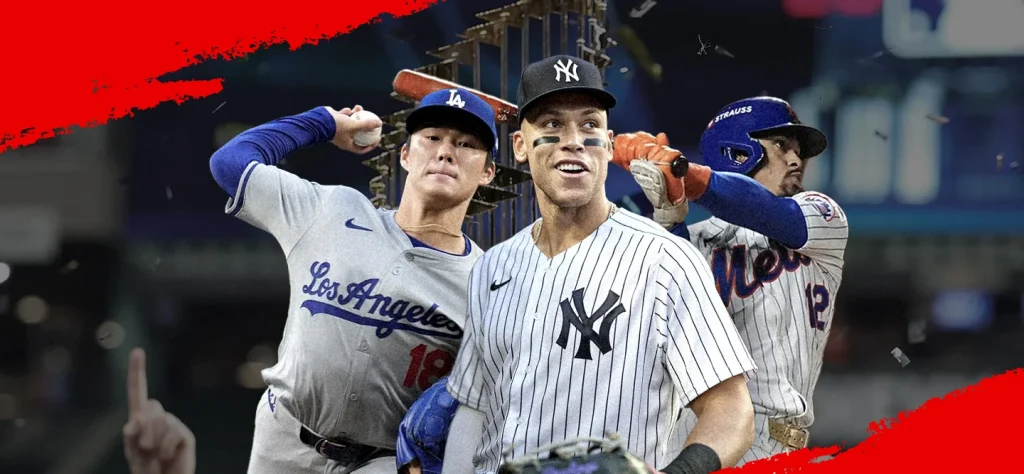
The regular MLB season is a grueling one. The post season often proving to be a survival of the fittest.
Some teams throw leads away, only to claw their way to victory in our top five greatest World Series comebacks.
1906 World Series
For the biggest upset in MLB history, we need to turn back time to 1906. Two Chicago-based clubs (the White Sox and Cubs) faced off in what was thought of as a very lopsided matchup.
The Cubs were major favourites, sporting a record-breaking 112-win season. Their team included Johnny Evers, Frank Chance, Johnny Kling, and Jimmy Sheckard. Add in two incredible pitchers in Ed Reulbach and Mordecai “Three Finger” Brown. Their ballpark was in the finer part of town.
The White Sox were from the south end of Chicago and known as the “Hitless Wonders” for their meager offence. Despite having the lowest batting average in the league (.230), they won the AL pennant. This was the Deadball Era, and the White Sox were trailblazers.
The World Series showcased the White Sox as 3-1 underdogs against the overly-confident Cubs.
What ensued shocked nearly everyone.
In Game 1, the White Sox pitcher held the Cubs’ offence to one run, while the offence managed two runs in plucky fashion.
The best underdog moment was when the Cubs taunted batter George Rohe, who responded by nailing a triple.
The White Sox pitcher proceeded to strike out 9 of 10, and the White Sox won the game. And eventually the series. It’s still considered one of the greatest World Series comebacks of all time.
1955 World Series
The Brooklyn Dodgers had a monkey on their back. Between 1941 and 1953, they’d been to the World Series five times with their cross-town rivals, the New York Yankees.
Without fail, they lost all five. But the 1955 season felt different. The club got a new manager in Walton Alston the season prior, and they started the new season with 10 straight wins on the backs of several MLB Hall of Famers including Roy Campanella, Duke Snider, Gil Hodges, Tommy Lasorda and Sandy Koufax.
Campanella and Snider had career seasons that year and finished first and second in MVP voting. By the end of the regular season, they led in several offensive categories (homeruns, runs, on-base percentage, doubles and walks).
The Dodgers made it to the World Series where they were pitted against the Yankees. The Yankees won the first two games of the series, making it look like a repeat of the old pattern.
But the momentum shifted when the series moved to the Dodgers’ home stadium in Game 3, and Dodgers sent Johnny Podres, who had a sad 9-10 record, to the mound. At that point, the Dodgers’ offence clicked, and Podres triumphed, in an 8-3 victory for Brooklyn.
By Game 4, the Dodgers evened the series, and they rode that momentum to Game 5. Unfortunately for the Dodgers, Snider had to leave Game 6 with an injury, and their offence struggled.
In the bottom of the sixth of Game 7, the Yankees had a golden opportunity with the tying run on base. The Dodgers’ manager made some defensive adjustments, putting “Sandy” Amoros in left field—and it was the perfect move.
Amoros ran full tilt to make an impossible catch, and managed to throw the ball to third for a double play that deflated the Yankees and guaranteed the Dodgers’ victory.
1969 World Series
In 1966, the Baltimore Orioles were on top of the world. They swept the dominant Dodgers, and established themselves as a powerhouse in the league. In 1969—the first season with the league’s divisional alignment—they had their best season ever, finishing 109-53—a record that still stands to this day. Frank Robinson, Brooks Robinson, Boog Powell and Paul Blair were key players on the Orioles’ roster.
After sweeping the Minnesota Twins, the Orioles proceeded to the World Series, where the New York Mets awaited.
Having just joined the MLB in 1962, the 100-62 Mets were a young team who were making the postseason for the first time. Game 1 of the World Series went as expected. The heavily favoured Orioles won 4-1, with pitcher Mike Cuellar putting forth an excellent performance. This gave the Orioles even more confidence in the series.
Game 2 was a back-and-forth affair. Mets’ pitcher Jerry Koosman had a killer performance on the mound, pitching six hitless innings. Meanwhile, the Mets’ offence led by Donn Clendenon (who’d be MVP of the World Series) hammered a homerun in the fourth for a 2-1 Mets victory.
The next game saw the Mets’ Tommie Agee have a career outing with several clutch plays, on top of hitting a homerun in the first. He made two historic catches that prevented the Orioles from mounting a comeback in the 5-0 Mets victory—it was a move that Mets Ron Swoboda replicated in New York’s Game 4 victory.
The Orioles entered Game 5 tense. They jumped out to a 3-0 lead with Dave McNally on the mound, but again, the momentum shifted when Mets manager put forth the famous “shoe polish” argument, where he said the Orioles’ pitcher hit Jones; he proceeded to prove his point by displaying the shoe polish that rubbed onto the ball. Jones was awarded first base as a result, and after getting knocking in two runs, and the Mets finished with a 5-3 victory and went down in history as “The Miracle Mets.”
1968 World Series
Homeruns in the 1960’s were getting out of control. Once Roger Maris hit 61 in 1961, the league responded by extending the strike zone.
1968 became known as the Year of the Pitcher. Cardinals Bob Gibson had 22 wins and 13 shutouts. Tigers Denny McLain had 31 wins and 6 shutouts. Both would face off in a historic World Series pitching duel.
In Game 1, Gibson broke Sandy Koufax’ 1963 World Series strikeout record of 15 with 17. Detroit bounced back in the second game, with pitcher Mickey Lolich hitting his first career homerun. He also limited the Cardinals to just six singles in the 8-1 Tigers win.
The Cardinals won the next two games, beating the Tigers by a combined score of 17-4.
Down 3-1 in the series, the Tigers fell further behind in Game 5, which they trailed 3-0, until they got lucky in the fourth inning with some careless play by the Cards.
Game 7 saw the Tigers send another pitcher who was short on rest (Mickey Lolich) to the mound, opposite of Gibson. No runs were scored until the seventh inning when Gibson gave up two-out singles that were followed by a hard hit to deep centrefield, where Cardinals center fielder Curt Flood misjudged the ball and couldn’t catch it. The Tigers went on to win 4-1 and became just the third team to overcome a 3-1 deficit to win the World Series.
2004 American League Championship
Lastly, we come to our final greatest comebacks in World Series history. But it’s a good one.
We just had to include this 2004 American League Championship Series because the outcome was so improbable.
The Red Sox reached the ALCS where they were up against their most despised rival, the New York Yankees. The Yankees had already eliminated the Red Sox in two postseasons in the prior five years.
Unfortunately for the Red Sox, it looked like the same old pattern would repeat in 2004. The Yankees led the series 3-0 and were three outs from winning Game 4 and sweeping Boston.
When New York brought in Mariano Rivera for a two-inning save in the eighth, Boston managed to secure the victory.
Not only did the Red Sox win Game 4, they went on to win the next three to eliminate their rivals. No team had ever mounted such a comeback.
You never know when we can add to the greatest comebacks in World Series history, but Ozoon will be there. Waiting. Watching. Hoping.