
When Team USA forward Jack Hughes fired the puck past Canadian goaltender Jordan Binnington for the golden goal, two neighbouring nations watched as one shot changed everything.
It seems like neither side could believe the outcome. American hockey fans witnessed what was arguably their program’s greatest accomplishment since the Miracle on Ice in 1980. On the other hand, Canadians were left shocked and dumbfounded after the team squandered so many quality chances.
While Hughes’ overtime heroics were the nail in the coffin for Team Canada, games of this magnitude are rarely decided by a single moment. There is a case to be made that Canada let the gold medal slip away. They failed to capitalize on quality scoring chances down the stretch. There is also a compelling argument that the United States earned this victory. They stepped up on the biggest stage and delivered when it mattered.
Breaking down this final means examining two sides of the same story: where Canada came up short, and where Team USA delivered when it mattered most.
Here’s why Team Canada Gave Away the Gold
Many Canadians are convinced that Team USA didn’t win the gold, so much as Canada simply gave it to them. Team Canada dominated in terms of shots and offensive possession, but was unable to get the job done.
Here are the key reasons why Canada gave away the gold:
Missed Scoring Chances
This was far and away the biggest reason why Team Canada failed to bring home the gold. They created enough quality scoring chances to win the final, but too many prime opportunities went unfinished. From Connor McDavid getting stopped on a breakaway to Nathan MacKinnon missing a wide open net. Throw in Devon Toews getting stopped in the crease by an improbable paddle save, and simply put, Canada missed out on far too many scoring chances.
Power Play Stalled
Team Canada had a number of power play chances in the final, including a five-on-three opportunity for over a minute. They failed to take advantage. While they maintained excellent puck movement, they seemed unable to break down a penalty kill where shooting lanes were limited and rebounds were scarce. Special teams can often be the difference between winning and losing, and Canada’s inability to capitalize with the man advantage left the door wide open for their opponent.
Lack of Net-Front Pressure
Too often during the gold medal game, Team USA’s goaltender had clear sightlines on shots, allowing saves to be made cleanly and confidently. Canada struggled to establish a consistent net-front presence that could create rebounds, deflections or second-chance opportunities. Without sustained traffic, even well-placed shots lose their effectiveness. In a game defined by narrow margins, the absence of chaos around the crease reduced Canada’s ability to turn pressure into goals.
Defensive Lapses at Key Moments
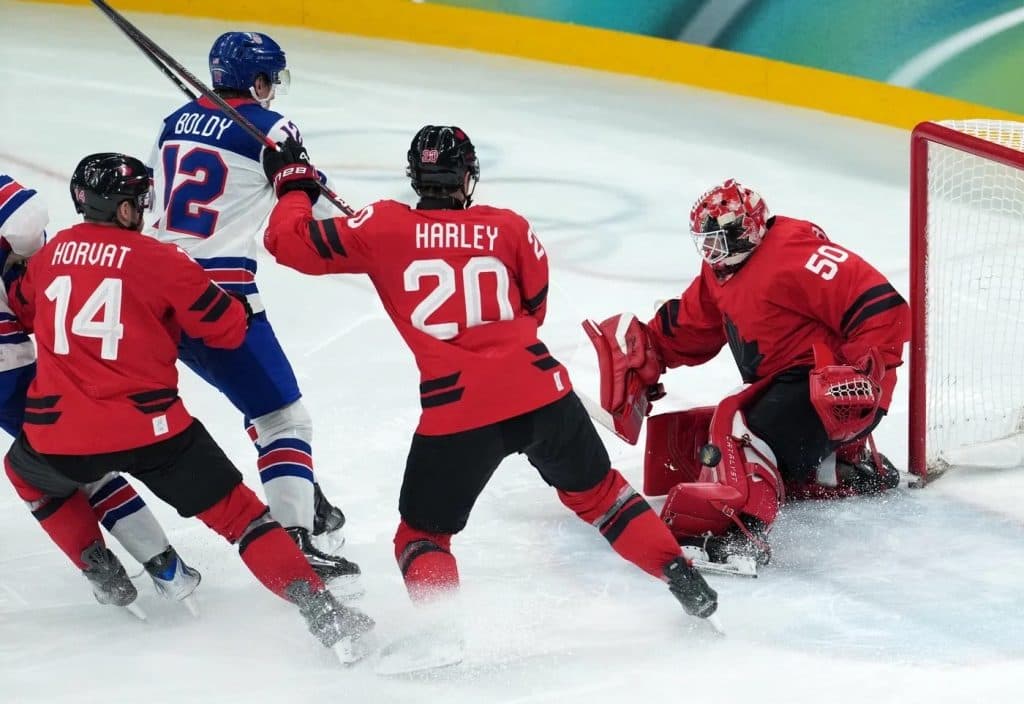
Canada defended responsibly for most of the game, but there were a few breakdowns that proved costly. The most obvious example is on the Americans’ opening goal, where Matt Boldy managed to split a pair of Canadian defenders. Mistakes like these simply cannot exist in a game of this magnitude. When chances are rare, even brief defensive lapses can shift momentum and ultimately decide a championship.
Here’s why Team USA Deserved Gold
This is a massive win for American hockey fans. After all, Team USA claimed its first Olympic gold medal in ice hockey in 46 years. They struck gold with an impressive performance against their biggest rival.
Here are the key reasons why Team USA deserves gold:
Clutch Goaltending
American goaltender Connor Hellebuyck made key saves time and time again throughout the final. He answered the bell whenever momentum threatened to swing Canada’s way. He turned away high-danger chances cleanly, controlled his rebounds and never wavered under pressure. In a gold medal game decided by a single goal, Team USA received exactly what championship teams need between the pipes: timely saves that kept belief alive until the decisive moment arrived.
Defensive Discipline
Team USA’s defensive structure was a major reason the game stayed within reach. They limited Canada’s second chances, protected the middle of the ice and forced their opponent to earn every inch. Defensive assignments were clearly defined throughout the game, so breakdowns were rare. Rather than chasing hits or overcommitting offensively, the Americans played smart in their own zone. That discipline prevented Canada from turning possession and shot volume into a winning advantage.
Patience Under Pressure
The United States displayed great patience and composure in the gold medal game, resisting the urge to force offence when Canada appeared to control long stretches of play. Instead, they trusted their structure and waited for opportunities to develop. In a game where one mistake could end it, Team USA’s ability to remain calm and stick to its game plan proved critical, especially as things got tense late in regulation.
Capitalizing in Overtime
When the game reached overtime, the margin for error disappeared, and Team USA was ready for that moment. Jack Hughes delivered the game-winning goal after losing some teeth to an errant stick earlier in the game. There was no hesitation, no overthinking, just a clean finish when it mattered most. That ability to seize the moment is what separates champions from runners-up, and Team USA delivered when gold was on the line.