
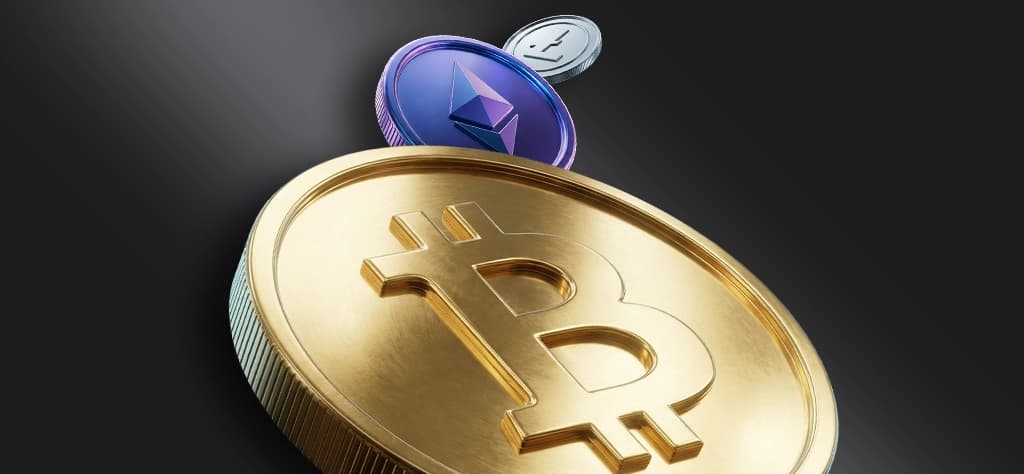
The internet as we know it today is over 30 years old. Crazy, right? Ozoon may be a new brand, but we’ve been on this information superhighway for decades, bringing the world of sports betting, casino games and poker to Canadians from sea to sea. It’s been quite a ride; we’ve seen an entire generation of new technology come and go, but nothing more groundbreaking than cryptocurrency – arguably the biggest game-changer of all. Let’s run through the most popular cryptocurrencies used for betting.
Cryptocurrency makes life so much easier when you’re moving money in and out of your Ozoon account. No more worrying about whether your bank or credit card company will block your transaction; crypto sidesteps all of that, while also giving you faster deposits and withdrawals at higher limits, with smaller transaction fees attached. Here’s a quick look at the six types of crypto you can use at Ozoon, starting with the granddaddy of them all. Check out our guide to popular cryptocurrencies used for betting for a deeper dive.
Bitcoin (BTC)
Bitcoin has been the dominant force in crypto since Satoshi Nakamoto (possibly a pseudonym, possibly a group of people rather than an individual) launched it in 2009, and its position at the top of the food chain hasn’t changed. Its security record is unmatched – the Bitcoin network itself has never been successfully hacked, at least not that we know of.
The early years were marked by scepticism from the mainstream financial world, but the launch of the first regulated Bitcoin futures contracts in 2017 marked a turning point. Institutional investors have been piling in ever since, pumping up the price of BTC to just over CDN $100,000 as we go to press. You can even keep track of the current price of Bitcoin on most of the major financial tickers.
While it might be the safest form of crypto you can use at Ozoon, Bitcoin isn’t always the cheapest or fastest option on this list. Transaction fees grow larger when network demand is high, and confirmation times can stretch to 30 minutes and beyond during these bottlenecks. If you’re making large deposits where the transaction costs are essentially a rounding error, those aren’t meaningful concerns, but if you’re topping up regularly with smaller amounts you might want to look further down this list.
Bitcoin Cash (BCH)
Bitcoin Cash was born out of a 2017 schism within the Bitcoin community over how to handle the network’s growing scalability problems. The split was contentious enough that it became known in crypto circles as “the great Bitcoin civil war,” with prominent developers and operators taking sides in a very public debate that played out over several years.
On one side, you had those pushing to increase Bitcoin’s block size (each “block” is a set of transaction records on the public ledger known as the “blockchain”) to allow more transactions per block; when that proposal was rejected by the larger majority on the other side, Bitcoin Cash was created as a separate chain, or “fork.”
For betting purposes, Bitcoin Cash works essentially the same as the original, and enjoys the same near-universal availability on crypto exchanges – but it’s much more nimble, and transaction fees are usually lower. BCH may not generate much excitement in the crypto press these days, but for a payment method, that’s the right kind of boring.
Bitcoin SV (BSV)
Bitcoin SV (the “SV” stands for “Satoshi Vision”) launched in 2018 as a hard fork of Bitcoin Cash, taking the scaling argument one step further. Its proponents, including original Bodog founder Calvin Ayre, sought massive increases in transaction capacity through much larger block sizes, while arguing that Bitcoin and Bitcoin Cash had strayed from the original Satoshi protocol.
This argument escalated into the “Hash War” of November 2018, where the two competing factions directed enormous amounts of computing power at each other in an attempt to establish dominance – one of the more unusual chapters in the history of digital finance. The result was a digital coin with even lower fees and faster confirmation times, making Bitcoin SV practical for bettors who make frequent deposits and withdrawals.
BSV remains a niche option compared to BTC, since its users aren’t as concerned about “holding” this digital coin as an investment. However, as a pure payment mechanism, Bitcoin SV performs reliably and cost-effectively.
Ethereum (ETH)
Now we enter the world of “alt-coins,” with Ethereum (launched in 2015) being the world’s most popular non-Bitcoin option. This is a different animal entirely; where Bitcoin and its forks function primarily as payment networks, Ethereum is a programmable blockchain where you can access all sorts of financial products and services. If you’ve been wondering what DeFi (Decentralized Finance) is all about, this is the place to start.
Ethereum was first proposed in 2013 by Vitalik Buterin, a 19-year-old computer programmer who grew up in Toronto after emigrating from Russia as a child. Buterin is one of the many math whizzes who went to the University of Waterloo, although he dropped out shortly before receiving a US$100,000 grant from the Thiel Fellowship (as in Peter Thiel, the “co-founder” of PayPal with Elon Musk and others).
The main issue with Buterin’s creation is the “gas” fees – the charges associated with processing transactions on the Ethereum network. As with Bitcoin, gas fees can spike when the network is congested, so once again, ETH is better suited for larger deposits where your fees represent a small percentage of the total transaction.
Litecoin (LTC)
Ethereum may be the leading alt-coin on the crypto market, but Litecoin was the first, arriving in 2011 as a lighter, faster alternative to BTC. Charlie Lee was a Google engineer when he launched Litecoin; in a time when Google still had “Don’t be evil” in its official code of conduct, Lee made headlines in 2017 when he sold his entire LTC stake, claiming he didn’t want any conflict of interest when it came to his public statements about Litecoin.
While Litecoin shares much of the same architecture as Bitcoin, it uses a different cryptographic algorithm that allows for quicker block generation. As a result, your average transaction fees are just a handful of pennies, and confirmation times are typically under 10 minutes.
For bettors at Ozoon who make frequent deposits and withdrawals, and want to minimize both friction and cost, Litecoin is well worth looking into. It also lacks the dizzying price fluctuations of Bitcoin and Ethereum, which is a feature rather than a bug if you’re using crypto as a payment mechanism rather than an investment vehicle.
USD Tether (USDT)
One of these things is not like the others. Tether (launched in 2014) is a “stablecoin” that’s been pegged 1:1 to the United States dollar, its value maintained through a reserve of assets held under the Tether corporate umbrella. Unlike Bitcoin or Ethereum, whose prices go up and down constantly, one USDT coin is always worth $1 in USD – give or take a tiny fraction of a cent.
Tether’s cost certainty means the value won’t change while sitting in a digital wallet, regardless of what the broader crypto market is doing. New digital coins are being minted every day, so you might eventually see additional forms of cryptocurrency on this list as we add them to the menu here at Ozoon. In the meantime, check out our Crypto FAQ and our video tutorial series to find out more about these coins and how to use them.