
It’s something we’ve all desperately wished for at some point in our lives. But despite our best efforts, and countless Disney movies, we still haven’t figured out how to travel back in time and change the past. Most scientists agree it’s impossible; some even say the future has also been carved in stone, and we’re just passengers along for the ride.
We can still dream, though. Imagine what the NFL would look like today with just one small tweak to the timeline – one single flap of a butterfly’s wings. Get your football galaxy brain ready, because here come our biggest “What If” scenarios in NFL history as chosen by our crack staff here at Ozoon.
What If Drew Bledsoe Doesn’t Get Hurt?
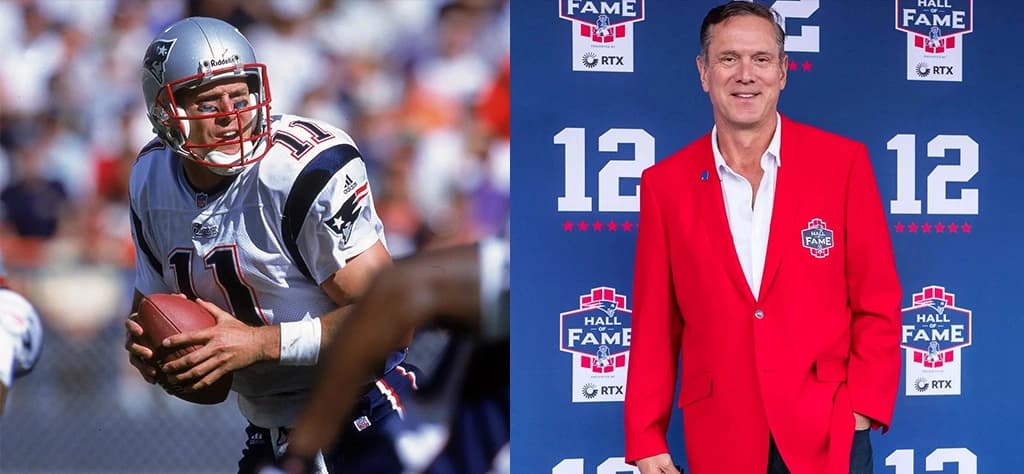
Once upon a time, the New England Patriots had easily the best quarterback they’d ever put in uniform: Drew Bledsoe, the No. 1 overall pick in the 1993 NFL Draft. Bledsoe had pretty much everything you ever wanted in a franchise QB back then, standing 6-foot-5 with a cannon for a right arm – he even excelled at both discus and javelin in high school, as well as football and basketball.
Bledsoe was so good, the Patriots signed him to a 10-year, $103-million contract in 2001, which was a record at the time. Then, during their Week 2 game against the New York Jets on September 23, Bledsoe was scampering for the sideline when he got trucked by Jets linebacker Mo Lewis. That hit sheared a blood vessel in Bledsoe’s chest, and left him lying in hospital for several days.
You probably know the rest. Bledsoe’s back-up was a sixth-round pick out of Michigan named Tom Brady; he came in for Bledsoe and never relinquished the job, winning six Super Bowls for New England and becoming the face of the league. But what if Lewis doesn’t hit Bledsoe with the same force? What if Jets defensive end Shaun Ellis hadn’t already clipped Bledsoe’s ankles, leaving him upright and vulnerable instead of diving out of bounds?
Here’s what happens in our new timeline: New England still wins all of those Super Bowls (the first three with Bledsoe at the controls) because Bill Belichick is still their head coach. As for Brady, his career turns out more like that of Matt Cassel, Brady’s back-up from 2005 through 2007. Cassel was a seventh-round pick out of USC who never got a start in college; Brady was stuck at Michigan behind Brian Griese, then nearly lost that starting gig again to Drew Henson. There are worse fates than making the Pro Bowl and earning $65.5 million over a 14-year career, but if you ask Cassel, he’d probably prefer our version of history, where Cassel takes over for the retiring Bledsoe and wins three rings of his own.
What If the Baltimore Colts Win Super Bowl III?
The NFL was in a strange place in 1969. Their merger with the American Football League was in its preliminary stages, with the two leagues keeping separate schedules and their respective champions meeting at the AFL-NFL World Championship Game. They even had two different unions, with the NFL Players Association (representing athletes from 16 teams) briefly going on strike in July 1968 while the remaining 10 teams under the AFLPA aegis conducted business as usual.
Everything changed on January 12, 1969 at Super Bowl III – the first of their title games to use the Super Bowl moniker (the previous two have since been retconned). The AFL franchises were still considered second-class and a financial drag on the “original” NFL teams despite all of the fees they were paying. The Green Bay Packers handily won the first two AFL-NFL championships as 14-point favourites, and the Baltimore Colts were as high as –19.5 heading into the Miami Orange Bowl to play the Jets.
Joe Namath wasn’t buying it. The flamboyant Jets QB publicly guaranteed victory for his team, and his prophecy was completed when New York won 16-7. Now the AFL had credibility and some added leverage when it came time to negotiate the completion of their merger. The Jets and the other nine AFL survivors were officially absorbed into the NFL after the 1969-70 season, with the league moving the Colts into the same AFC East division as New York when they realigned, and paying them $3 million for their trouble.
There have been several realignments since then – the Colts are now the Indianapolis Colts, and they’re in the AFC South – but without that Jets victory, the NFL ends up on a very different path. Instead of moving the Colts to the new AFC conference alongside the Cleveland Browns and Pittsburgh Steelers, the old NFL guard gets its way and things look more like Major League Baseball, with the AFL still its “own” league (at least in spirit) with its own schedule, plus an additional 30-50 interleague games.
What If They Flag the Immaculate Reception?
Football is a game of inches, where you can snatch victory from the jaws of defeat and put your name in the record books – like Steelers RB Franco Harris did on December 23, 1972 in the AFC Divisional Playoffs. Trailing 7-6 to the Oakland Raiders, with just 22 seconds left and the ball at his own 40-yard line on fourth down, QB Terry Bradshaw throws up a prayer. The ball takes a lucky bounce, Franco makes a shoestring catch, and he rumbles into the end zone. Final score: Oakland 7, Pittsburgh 13.
The Steelers went on to lose the AFC Championship Game to the undefeated Miami Dolphins, but this was the first playoff win for the franchise since their founding in 1933 as the Pittsburgh Pirates. Six Super Bowl rings would follow, the first four with Bradshaw and Harris leading the way. Football fans have been getting a regular Sunday dose of Bradshaw ever since.
It’s been debated since the moment it happened: Did the ball bounce off Steelers RB John Fuqua (Bradshaw’s intended target), or did it bounce off the helmet of Raiders safety Jack Tatum? Did it hit both; if so, in what order? Upon further review, our time builders have overturned the Immaculate Reception – not for the ball contact, but for Pittsburgh TE John McMakin blocking Raiders LB Phil Villapiano from behind after Harris made the catch.
That 15-yard clipping penalty gives Pittsburgh the ball at roughly the Oakland 45-50, and it’s 1st-and-25 with maybe five seconds left. NFL goalposts won’t get moved to the back of the end zone until 1974, but robo-kickers haven’t been invented yet (Tom Dempsey notwithstanding), and immaculate lightning doesn’t strike twice in this timeline; much like Brady above, Bradshaw goes on to be remembered as just another decent “game manager” quarterback, if anyone remembers him at all.
What If the USFL Wins Serious Money in Their Lawsuit?
Imagine taking the NFL to court – and winning. That’s what the United States Football League – Donald Trump included – did in 1986 as the fledgling league was trying to stay afloat. On July 29, a jury of six people decided the NFL was indeed a “duly adjudicated illegal monopoly” that used predatory tactics to stay on top. But they also denied most of the USFL’s other claims, and awarded them nominal damages of $1. That penalty was tripled to $3 under antitrust law, and a cheque was eventually written for $3.76 with interest added, but never cashed.
The verdict led to the dissolution of the USFL, and Trump’s ongoing personal vendetta against the NFL. The biggest beneficiaries may have been the Buffalo Bills, who signed up all the USFL refugees they could – including former Chicago Blitz (and Montreal Alouettes) head coach Marv Levy, who led them to four straight Super Bowl appearances. Not only do those disappear in our new timeline, the breaking of the monopoly also leads to exactly the scenario we just described with the AFL and NFL: two equal(ish) leagues under the same umbrella.
Also, Trump doesn’t run for President of the United States in 2016, since he’s happy with his New Jersey Generals. He did tell the Associated Press during the primaries that he wouldn’t be putting his name in the hat if he’d been allowed to buy the Bills in 2014 after Ralph Wilson died. And of course, Generals QB Doug Flutie doesn’t join the CFL and win three Grey Cups (one with the Calgary Stampeders, two with the Toronto Argonauts) in this scenario.
There were other “What If” moments that could have impacted the CFL even more, like if Montreal sports executive Gerry Snyder had been awarded an NFL franchise in the 1970s to pair with his launch of the Montreal Expos – or if the USFL and CFL had merged in 1987. But we’ll take the USFL lawsuit as the most pivotal moment of them all for the NFL itself and society as a whole. And while none of these things happened in real life, to paraphrase Douglas Adams, time is an illusion. Game time doubly so.