
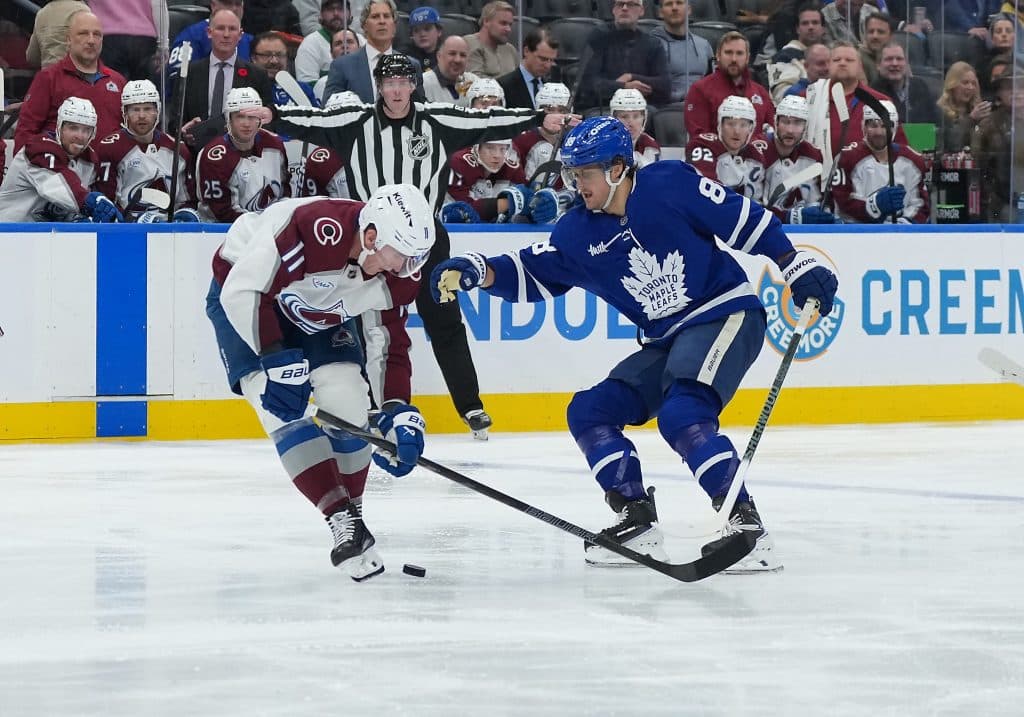
William Nylander is averaging a point a game, but as Ozoon’s David Alter writes, his struggles could slowly drown the Maple Leafs’ season.
Nylander’s production has been uneven through 20 games, and the underlying numbers at five-on-five underscore why the Toronto Maple Leafs’ recent slide has been so difficult to reverse.
Nylander has 11 goals and 11 assists for 22 points, a pace that still projects toward a strong season on the surface. Eight of those points, however, have come on the power play. At five-on-five, the Leafs have controlled only about 44.3 percent of shot attempts with him on the ice, a figure that ranks near the bottom of the league among forwards. They have been outscored 13-18 in those minutes and have generated roughly 40 percent of the expected goals, per NaturalStatTrick.com data. He has also been on the ice for more five-on-five goals against than any other Toronto skater, even while starting a high percentage of his shifts in the offensive zone.
The gap is especially stark when compared to time spent with Kirill Marchenko earlier in the season. Nylander’s on-ice expected goals percentage at five-on-five sits at 55 percent in 65 minutes alongside Marchenko; without him, that number drops to 36 percent over more than 228 minutes. Marchenko’s absence has left Nylander searching for the same driving force he provided in the first weeks of the year.
In Tuesday’s 6-3 loss to the Colorado Avalanche, Nylander finished with zero points, zero shots and a minus-4 in 15:54 of ice time. It was the latest entry in a stretch that has seen the Leafs drop four straight games in regulation and six of their last seven overall, sitting at 8-10-2. The issues have been concentrated at home, where the team has struggled to generate consistent offense and has spent too much time defending.
Nylander has acknowledged the disconnect.
“I’ve got to try to get the puck more on my stick,” he said. “I’m just getting around there with no puck on my stick, so that makes it hard to generate. But trying to work without the puck, that’s what you can do when you don’t have the puck on your stick.”
He pushed back on the idea of a prolonged slump, noting he scored against Montreal earlier in the homestand, but conceded that chances have been harder to come by.
“It’s tough when I don’t have the puck on my stick to do anything offensively, so that’s where you’ve got to start.”
John Tavares, who has been reunited with Nylander after missing time with a lower-body injury, offered a similar assessment of the line’s recent work.
On the defensive-zone issues that have drawn attention, Tavares was direct:
“You just got to do your job and you got to do it at a high level, understand your role and responsibility and go out there and execute it,” Tavares said. He described Nylander as “one of the best game breakers in the league” and said no one expects more from the winger than Nylander does of himself.
Head coach Jim Hiller has tried to frame the stretch as one of overthinking rather than a fundamental decline. “
I think he’s trying. I think what happens to a lot of us is we get in our own head a little bit. And he wants to do well for the team. His heart’s in the right place,” Hiller said. “He knows he’s not playing his best. That’s obvious, and he wants to. And we just got to help him try to clear it out and just free himself and get him out there just skating and playing. So I think he’s maybe overthinking a little bit right now.”
Hiller has also pointed to deployment factors. Tavares is still working his way back after missing nearly a month, and the Leafs have been limited by injuries at center.
“I don’t think it’s fair to evaluate John coming off a month-long injury,” Hiller said. “I think they’re probably not spending enough time in the offensive end. And so, to me, if you don’t spend time in the offensive end, you spend time in your own end. When you spend time in your own end, sooner or later, bad things are going to happen.” He noted that the pair’s offensive-zone time is down this season and expressed hope that more sustained time with the puck in the other end will follow once Tavares is fully up to speed.
Nylander has largely brushed off external noise about his future, a topic that has followed him for much of his decade in Toronto.
“I’ve been here for 10 years. People have been saying I’m going to get traded for the majority of it, so it is what it is,” he said.
The excuses though, don’t help the fact that this a a club struggling fast. There are key players missing, but they can ill afford to stay on the wrong end of results, otherwise they are looking at another potential lost season. And if that happens, there will be core players wondering if they want to stick around.