
Winning one Stanley Cup is hard enough for most NHL dynasties. Winning multiple Cups while staying at the top year after year is something only a handful of teams have managed since the NHL introduced the salary cap in 2005.
Unlike previous eras, today’s NHL is built to create parity. Star players eventually get paid, depth becomes harder to keep together and every offseason forces contenders to make difficult decisions. That makes true dynasties much rarer than they used to be.
Still, a few franchises have found ways to build something special. Whether it was through elite drafting, smart roster management or having generational talent leading the way, these teams didn’t just win championships. They defined an era of hockey and set the standard everyone else was chasing.
There’s always room for debate when it comes to hockey dynasties, but the five teams below stand above the rest in the salary cap era.
Chicago Blackhawks (2010-2015)
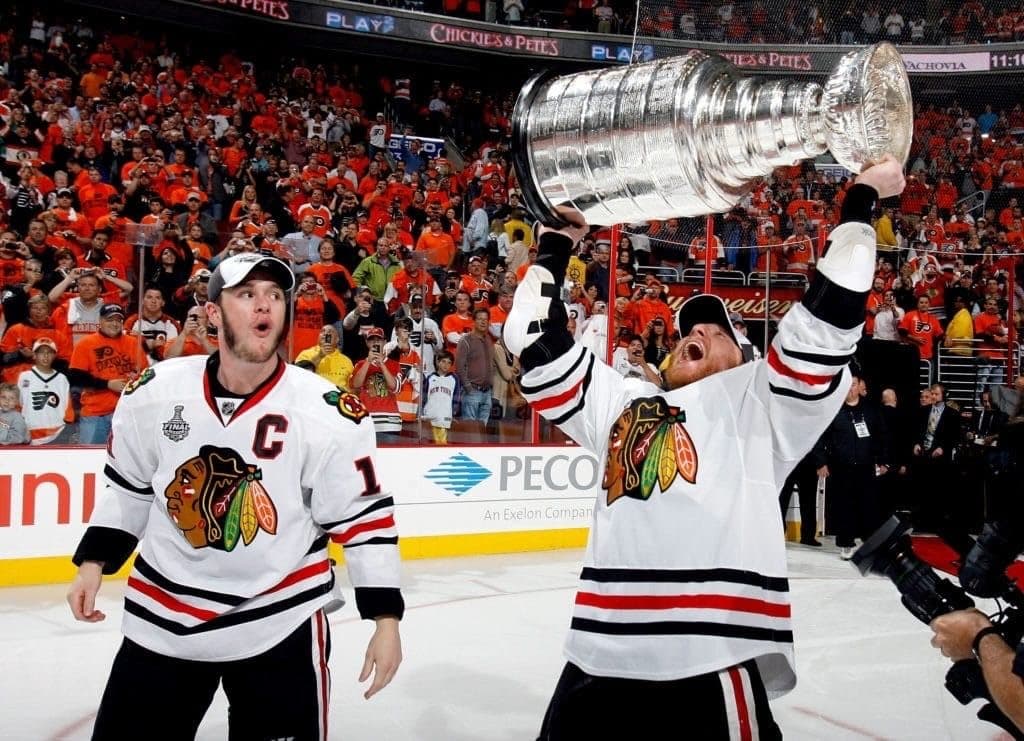
If there’s one team that defines the salary cap era, it’s the Chicago Blackhawks. Winning three Stanley Cups in six seasons is impressive in any era, but doing it under a hard salary cap is an entirely different challenge.
Built around Jonathan Toews, Patrick Kane, Duncan Keith, Brent Seabrook and later Marian Hossa, the Blackhawks combined elite talent with outstanding player development. They consistently found impact players through the draft while making smart additions to keep their championship window open.
Chicago’s puck possession, speed and depth made them one of the toughest teams to play against throughout the early 2010s. Their run included championships in 2010, 2013 and 2015, cementing their place as the gold standard of the salary cap era. Few teams have managed to stay on top for that long in such a competitive league, which is why Chicago remains the benchmark all modern NHL dynasties are measured against.
Pittsburgh Penguins (2008-2017)
If we’re talking NHL dynasties, the Pittsburgh Penguins were one of the league’s most consistent contenders throughout the late 2000s and 2010s. Their dynasty began with a trip to the Stanley Cup Final in 2008 before they bounced back the following year to defeat the Detroit Red Wings and capture their first championship of the salary cap era.
From there, Pittsburgh remained one of the league’s premier teams. Led by Sidney Crosby and Evgeni Malkin, the Penguins combined elite star power with impressive depth, eventually adding two more Stanley Cups in 2016 and 2017.
While the roster evolved over the years, the foundation stayed the same. Crosby’s leadership, Malkin’s offensive brilliance and Kris Letang’s steady presence on the blue line gave Pittsburgh a core few teams could match.
Reaching four Stanley Cup Finals and winning three championships across a 10-year span is an incredible achievement in today’s NHL. The Penguins proved that with the right core in place, sustained success is still possible, even in one of the most competitive eras in hockey history.
Tampa Bay Lightning (2020–2022)
Few teams have dominated a three-year stretch quite like the Tampa Bay Lightning. After falling short in previous playoff runs, the Lightning finally broke through with back-to-back Stanley Cup championships in 2020 and 2021 before returning to the Final again in 2022.
Every great dynasty needs a superstar core, and Tampa Bay had one of the league’s best. Nikita Kucherov was one of the league’s most dynamic offensive players, Victor Hedman anchored the blue line and Andrei Vasilevskiy established himself as arguably the NHL’s best goaltender. Add Brayden Point and Steven Stamkos to the mix and it was easy to see why the Lightning were so difficult to beat.
Back-to-back Stanley Cups and three consecutive finals appearances are achievements few teams can match in the salary cap era. For several years, every road to the championship seemed to go through Tampa Bay, making the Lightning one of the defining dynasties of modern hockey.
Florida Panthers (2023–2025)
The Florida Panthers have quickly established themselves as one of the leading NHL dynasties in the modern era. After reaching the Stanley Cup Final in 2023, they followed it up with back-to-back championships in 2024 and 2025, proving they weren’t just on a hot streak. They had become the team everyone else was trying to beat.
Florida’s success was built around a relentless style of hockey that thrived in the playoffs. Aleksander Barkov led by example, Matthew Tkachuk brought the skill and edge, while Sam Reinhart, Sergei Bobrovsky and a deep supporting cast gave the Panthers the firepower to compete with anyone.
Three straight Stanley Cup Final appearances and two championships are enough to put Florida among the salary cap era’s elite. What’s even more impressive is that their dynasty may not be over. After another aggressive offseason, the Panthers enter the 2026-27 season with a roster capable of making another serious run at the Stanley Cup.
Los Angeles Kings (2012–2014)
Some hockey fans may argue that calling the Los Angeles Kings a dynasty is a bit of a stretch, but there’s no denying they deserve a place in this conversation. Winning two Stanley Cups in three seasons is an incredible accomplishment, especially during the salary cap era when sustained success is so difficult to achieve.
The Kings were built differently than most championship teams. They relied on elite defence, physical play and outstanding goaltending rather than overwhelming offensive firepower. Jonathan Quick was nearly unbeatable during his prime, while Anze Kopitar, Drew Doughty and Dustin Brown formed the backbone of a team that always seemed to raise its game in the playoffs.
Los Angeles captured the Stanley Cup in 2012 and 2014, including an unforgettable 2012 run as the eighth seed. While their championship window wasn’t as long as some of the other teams on this list, their dominance during those peak years earns them an honourable place among the salary cap era’s greatest teams.