
Every October, baseball gives us the same familiar debate: can money buy a championship? It’s a pretty reasonable question when you consider that MLB has no hard salary cap, and the gap between the sport’s highest- and lowest-spending teams is enormous.
The Los Angeles Dodgers entered this season with a payroll north of $300 million, while several postseason teams operated with payrolls well below $100 million. And yet, here we are in October, with some of baseball’s biggest spenders sharing the postseason spotlight with teams that took a very different route to get there.
That makes the 2026 playoffs an interesting test of one of baseball’s oldest arguments: does spending more actually give you a better chance to win it all? The short answer is yes. But it’s nowhere near that simple.
Money Still Matters
It would be silly to pretend payroll doesn’t matter. Teams with more money can afford more established stars, deeper pitching staffs and more expensive depth when injuries inevitably pile up over a 162-game season.
They can also absorb mistakes that would cripple a lower-budget club. If an expensive player does not work out, a wealthy team can move on. If the bullpen needs help in July, it can make another trade. If a star becomes available, it can at least enter the conversation.
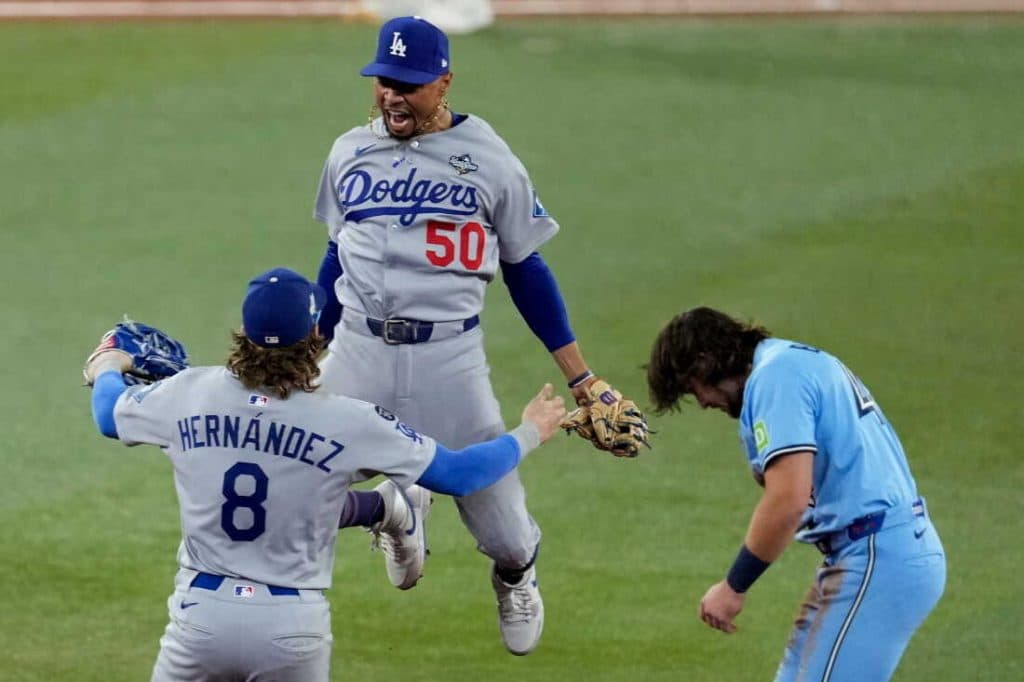
The Dodgers are perhaps the clearest example. Their spending has helped turn them into one of baseball’s most consistently dominant organizations, and they entered this postseason trying to become the first team in more than two decades to win three consecutive World Series. Money has clearly helped put them in that position.
Small-Market Teams Can Still Make Things Interesting
Look at the other end of the spectrum, though, and the picture gets a lot more complicated. Tampa Bay entered the postseason with one of MLB’s lowest payrolls and still won 98 games and the American League East. Milwaukee, another relatively low-spending club, won 103 games and finished with the best record in the National League.
That is more than just a collection of fun underdog stories. It raises a bigger question about how teams actually build winners. Some teams lean heavily on homegrown talent. Others are aggressive traders. Others spend big in free agency. Small-market teams like the Rays and Brewers have developed reputations for finding value in places where other organizations might not be looking. MLB’s current playoff field shows that there is more than one way to construct a contender.
Spending Big Is Not the Same as Spending Well
If spending $300 million automatically produced a championship, there would be no reason to play the games. The New York Mets provided a pretty good reminder of that this season. They entered the year with MLB’s highest payroll and still missed the playoffs, while the Guardians and White Sox reached October with two of the league’s lowest payrolls.
That does not mean spending is pointless. It means spending itself is not a strategy. A front office still has to identify the right players, develop young talent, make smart trades and build a roster that actually fits together. Spending $20 million on the wrong player does not magically make him a $20 million player. In some cases, a lower-budget team can actually have an advantage because it has been forced to become better at finding undervalued players and developing its own talent.
Clubs like the Rays and Brewers cannot simply outbid the competition, so they have had to find other ways to compete. That means scouting, player development, analytics and roster creativity become even more important. They’re not winning by playing the same financial game as the richest teams with less money. They are trying to play a different game altogether.
October Changes Everything
There is another reason money has a harder time translating into championships in baseball: the playoffs are a small sample size. Over 162 games, talent has plenty of time to separate itself. A great roster can overcome injuries, slumps and the occasional disaster. Over a short playoff series, there is much less room for that advantage to reveal itself.
A superstar can go cold at exactly the wrong time. A dominant pitcher can have one terrible inning. A bullpen can implode. A team that won 100 games can run into another team that happens to be playing better baseball that week. Suddenly, the difference between a $300 million roster and a $100 million roster does not look quite as enormous as it did in April.
That unpredictability is one of the things that makes baseball different from other major sports. The better team usually has an advantage, but it does not have nearly as much control over the outcome as we sometimes assume. And that is especially true once October arrives.
So, Can Money Buy a World Series?
Not exactly. What money can buy is a better starting position. A massive payroll can give a team more talent, more depth and more ways to survive the inevitable problems of a long season. The fact that so many high-payroll teams consistently make the playoffs is evidence enough.
But money cannot buy certainty. Once October arrives, all bets are off. The richest teams can spend their way into contention, but they cannot spend their way through every bad inning, cold streak or unlucky bounce.
That may be the real lesson from this year’s postseason. The biggest spenders still have an advantage, and pretending otherwise would be misleading. But MLB has not become a league where the biggest cheque automatically gets the trophy. There are still multiple ways to build a winner, and once the playoffs begin, even the most expensive roster has to prove itself on the field.
Money can buy talent. It can buy depth. It can buy options. What it cannot buy is October itself.